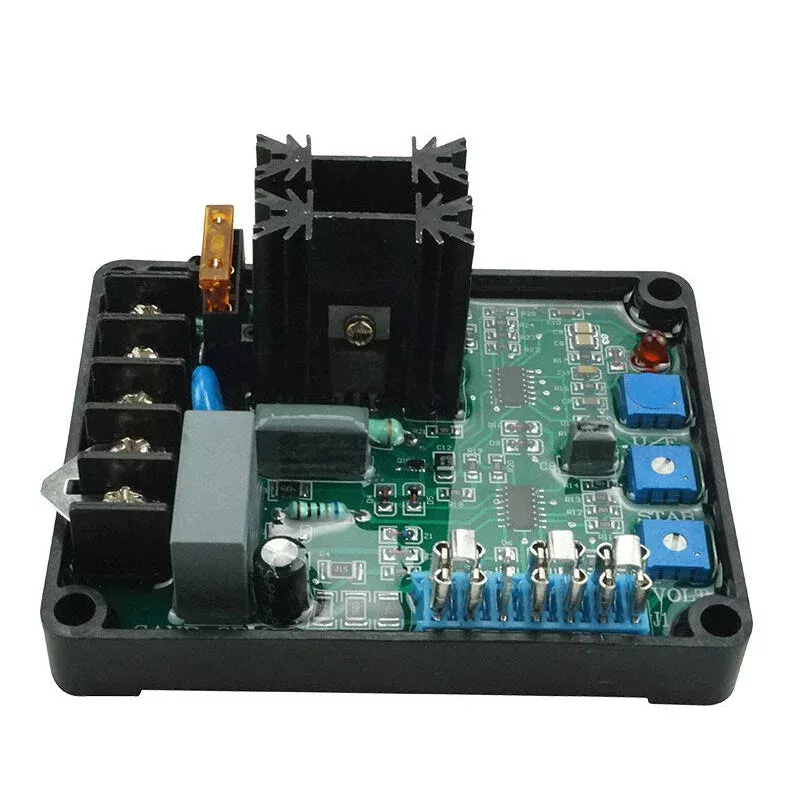
| Product Name | GAVR-8A Automatic Voltage Regulator | |
| Sensing/Power input | Voltage | 110/220/400Vac,1 phase ,2wires |
| Frequency | 50/60 Hz jumper selectable | |
| Output | Voltage | Max 95Vdc,240Vac input |
| Current | Continuous 8A | |
| Apply for | Output | 100KW below generator |
GAVR-8A Automatic Voltage Regulator features a rugged compact design, 110/220/400 VAC Programmable Input with Under Frequency Protection. Also features Soft Start Voltage Ramping and EMI Suppression and a built-in high capacity 8 Amp Fuse to protect the unit in cases of power surges. Package includes 1 x AVRGAVR-8A and 1 x User Manual.
Technical Specifications of the GAVR-8A Automatic Voltage Regulator
- SENSING INPUT: Voltage : 110/220/400V AC MAX; Frequency : 50-60 Hz nominal
- POWER INPUT: Voltage : 95-270VAC MAX; Frequency : 50-60 Hz nominal
- OUTPUT: Voltage : max 95V DC at 240V AC input; Current : continuous 8A
Reasons for using the GAVR-8A Automatic Voltage Regulator
Power generators, as ones used by standby power systems, will have automatic voltage regulators to stabilise their voltages as the load on the generators fluctuates. Originally, AVRs for generators were electromechanical in nature, but a modern AVR uses solid-state devices. An AVR acts as an feedback control system that gauges the output voltage of the generator, compares that output to a set reference point, and generates an error signal that is used to adjust the excitation of the generator. As the excitation current in the field winding of the generator increases, its terminal voltage will increase. The AVR will control current by using power electronic devices; generally a fraction of the generators output is used to feed current for the field. Where a generator is connected in parallel with other sources such as an electrical transmission grid, changing the excitation has more of an effect on the reactive power produced by the generator than on its terminal voltage, which is mostly set by the connected power system.